
Ding!
A notification from your email pops up.
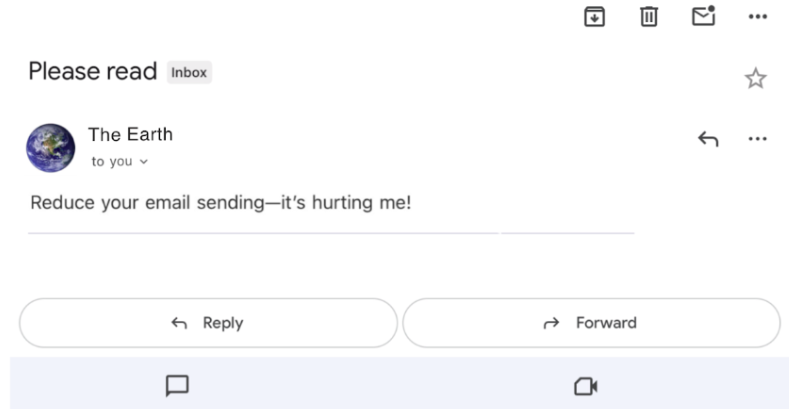
At first, the message seems exaggerated and unrealistic, almost like a joke. The idea that the Earth could be affected by something as simple as an email feels impossible. But if you follow that thought, it makes you wonder—are you actually harming the Earth by sending emails?
To answer this question, let’s explore what happens behind the scenes of every email you send.
Clicking “send” doesn’t just magically transport an email; it has to travel through modems, routers, internet cables, and servers before finally arriving in someone’s inbox. Because of this, each email requires energy to power the devices, servers, and data centers used for its transmission and storage.
The amount of CO2 released by each email is measured in Carbon Dioxide Equivalent (CO2e), a unit that combines different greenhouse gases into a single value based on their impact on global warming. Essentially, it refers to the amount of CO2 that would cause the same amount of global warming as what’s being measured. The carbon emissions of an email are heavily based on its size. Sending an email with no attachments creates around 0.3g of CO2e, while emails with large attachments can produce up to 50g of CO2e. Although the carbon footprint of a single email may seem insignificant, it accumulates to a staggering total through the everyday deluge of spam, work emails, and newsletters.
A single person’s annual email activity can contribute around three to 40 kilograms of CO2e per year. To put this into perspective, that’s the same amount of energy used for 10 minutes to 3 hours of flight on a commercial plane, depending on the amount of emails sent and stored in your inbox throughout the year.
Looking at the bigger picture, billions of emails are sent every day by people all around the world; these messages often carry an unnecessary amount of digital waste. Even small details like email signatures, which are added automatically to every message, can increase the size and energy use of emails, especially when multiplied over millions of times. Additionally, emails are often stored indefinitely on servers, consuming data long after they’re sent. When actions like these are done on a large scale, they snowball into an avalanche of carbon emissions.
Our carbon footprint and greenhouse gas emissions have been rapidly increasing throughout the years, leading to a rise in global temperature. In today’s society, which is mostly powered by fossil fuels, the energy we consume is linked to the amount of CO2 released in the atmosphere. The majority of the energy used to power our data centers still comes from fossil fuels. Every watt generated this way releases greenhouse gases, which strengthens the blanket that traps heat in our atmosphere. This warming has been gradually changing our world, leading to rising seas, melting ice, and extreme weather.
Although sending emails is not the main cause of climate change, it plays a role in increasing energy consumption. Our everyday digital practices, even ones that seem harmless, still contribute to environmental problems. So does sending an email hurt the planet? The answer lies in how it is powered. The most effective solution is not sending less emails, but to ensure that the data centers that handle them run on renewable energy. This is the change that is needed to prevent our digital activity from overheating our planet.
Sources:
https://againstdata.com/blog/top-facts-and-questions-about-the-carbon-footprint-of-email
https://shunwaste.com/article/is-sending-emails-bad-for-the-environment