A Crime Written in Blood: Blood Spatter Analysis
The door creaks open into a dimly lit room. A chair is overturned, the air thick, tension still in the air. A broken window exposes a clear view of the building on the other side of the empty street. A man lies collapsed beside his living room window on the 15th floor. Around him are shattered glass and a faint mist of blood against the wall. From this data, investigators reconstruct the past and identify the culprit.
There were no shell casings, no signs of forced entry, and the neighbors heard only the sound of the shattering of a window. One thing is immediately clear: The victim had been shot through his own window.
On the opposite side of the street stood a nearly identical building, a grid of windows, one of which might conceal a murderer.
Inside the apartment, forensic scientists studied bloodstains on the wall. Each droplet was observed to have a tail pointed upward, suggesting that the bullet originated from a floor below the position of the victim. If the droplets had a downward tail, that would indicate that the shot came from a higher floor.
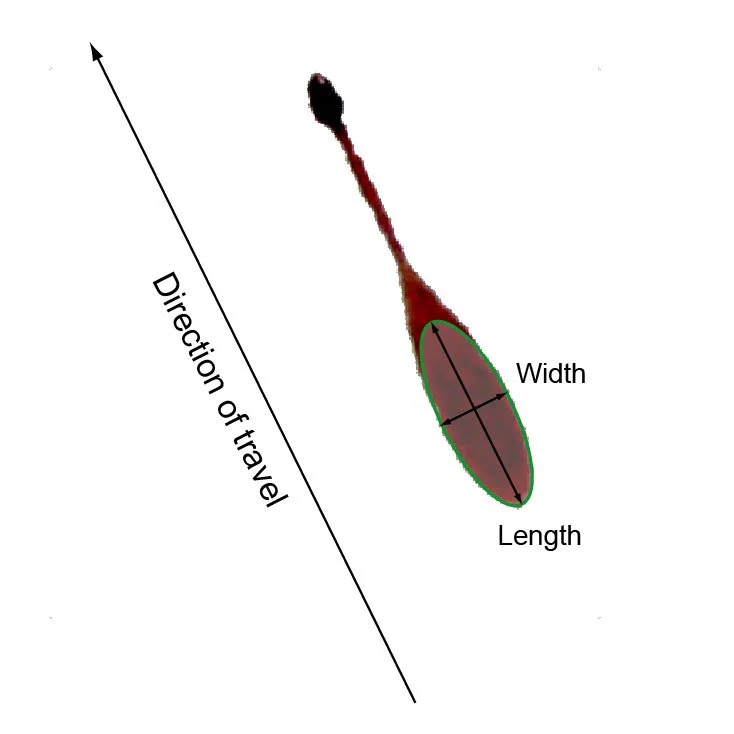
This is the foundation of an important principle in forensic science, bloodstain pattern analysis (BPA). BPA is a forensic discipline that analyzes the size, shape, distribution, and location of bloodstains to reconstruct the events leading to their formation. When a droplet of blood hits a surface, its shape is determined by the impact speed and angle. For example, a gunshot would yield droplets approximately 1mm in size, while a knife would cause droplets of around 2-4mm in size. These laws of physics enable forensic experts to reverse-engineer the stain to determine its point of origin.
With the victim on the 15th floor, the question becomes one of geometry. If the bullet had come horizontally from the opposing building, its trajectory must have been one that matches exactly with the rising tails of the blood droplets and the break in the window glass.
By extending the trajectory line, the forensic scientists may determine the vertical and horizontal angles of the shot through a simple trigonometric relationship:
sin(θ) = width of stain/length of stain
After calculating the angle of multiple droplets, imaginary lines are traced backward to a common point or the point of origin of the shot.
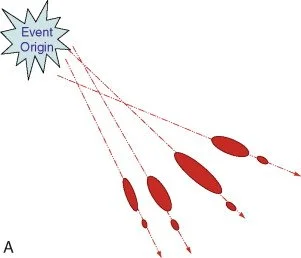
Only a handful of windows aligned with the bullet.’s trajectory. When authorities searched the corresponding apartments, one unit immediately stood out – inside was a rifle positioned adjacent to the window, surrounded by shell casings that matched the evidence.
When questioned, the shooter claimed to have never met the victim. However, further investigation told otherwise. Rental records showed that the victim had been living in the apartment for only two weeks. However, the man across the street had been watching the window for months, waiting for someone entirely different. Turns out, the man on the 15th floor had never been the intended target.
This case illustrates how forensic science turns what appears to be a chaotic crime scene into accurate, measurable data. There were no witnesses to the shooting, nor any confessions, but through the application of simple physics principles, the unknown was made known.
Sources:
https://www.forensicsciencesimplified.org/blood/
https://physicsworld.com/a/the-physics-of-blood-spatter/
https://www.ebsco.com/research-starters/health-and-medicine/blood-spatter-analysis