This is my cat!

You would not want her falling from a 100-story building, but according to science, she might walk away just fine!
Have you ever dropped your cat—accidentally, of course—and wondered how they stick the landing every time? Whether leaping from a windowsill, a tree branch, or even a 32-story building, cats seem to defy physics itself. Their elegant midair twist, performed with seemingly no initial rotation and pushback, has baffled physicists for well over a hundred years! For instance, the physiologist Étienne-Jules Marey presented a series of high-speed photographs that showcased the process.
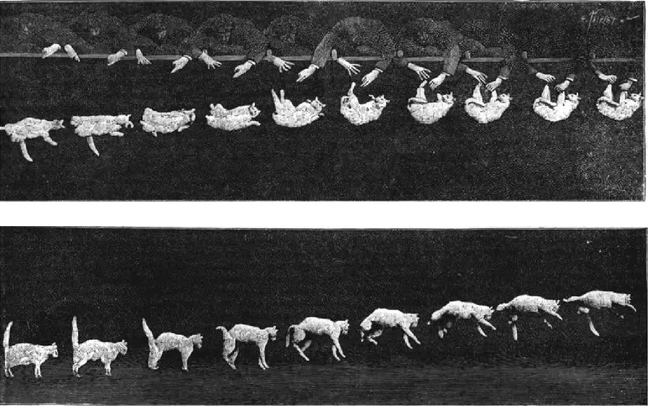
After all, according to one of Newton’s laws, every action requires an equal and opposite reaction. If the cat were free-falling, how would it spin at all?
The secret lies in two important concepts: angular momentum and inertia. When an object spins, it naturally wants to keep spinning in the same direction unless an outside force interferes. However, the object does not necessarily have to spin in one specific direction.
When a cat falls, it bends in the middle, and both its front and back halves rotate in opposite directions. This motion allows the two forces to cancel each other out, enabling the cat to rotate without violating the laws of physics.
At the same time, it tucks in its front legs, reducing inertia and making it easier for that part to rotate. Think of an ice skater spinning on the ice—when they pull their arms in, they spin dramatically faster. This concept makes it possible to counteract the forces of motion that would otherwise keep the cat in the same orientation as it falls.
Thus, would this mean that the cat theoretically survives? In theory, the cat would reach its terminal velocity, or the maximum speed an object can reach as it falls through a fluid. In our unfortunate feline’s case, it would reach a terminal velocity of 60mph, which is survivable for their species. However, this does not mean that they are indestructible. While many cats have survived drops at this speed, the height would most likely disorient the cat and cause broken limbs or internal trauma.
However, note that their impressive trick only gives them a chance to survive, so please do not try this at home. But if you do, beware the wrath of their remaining eight lives!
Sources:
https://www.sciencefacts.net/can-cats-survive-terminal-velocity.html
https://skullsinthestars.com/2014/02/05/how-do-cats-land-on-their-feet-when-falling-anyway
https://byjus.com/physics/angular-momentum
https://www.britannica.com/science/inertia
https://www.britannica.com/science/inertia
https://publicdomainreview.org/collection/photographs-of-a-falling-cat-1894
https://www.grc.nasa.gov/www/k-12/VirtualAero/BottleRocket/airplane/termv.html